Showing posts with label Technology. Show all posts

Tuesday, January 01, 2013

IN AND OUT 2013: All the rest

We admit, the Overly Attached Girlfriend meme makes us nervous.
Of all the things that are in, we’d be hard pressed to find something more in than frozen yogurt. That’s the only explanation for the glut of frozen yogurt establishments bursting from the ground fully formed, like Superman’s Fortress of Solitude. By process of elimination, that would probably mean ice cream is out … But just try getting between us and our Chunky Monkey.

Tablets, particularly iPads, are in – people carry them around now like your gym teacher used to carry around that stupid clipboard. But don’t worry, your smartphone is still in, at least until they figure out how to attach an iPad to the side of your head while you drive. And now that everyone has a tablet, laptops are on their way out, and all the desktop computers have now been dismantled and turned into yogurt shops.

As far as the types of phones that are in, Blackberries are now being used primarily to keep napkins from flying off picnic tables, and even the iPhone has lost some of its sheen since the iPhone 5 wound up requiring all sorts of new chargers and cables. (Chargers and cables are out.) The Samsung Galaxy is the new in hip phone: We know that because the commercials tell us they are. Commercials are in.

Online, creating memes and then distributing them via Instagram is in. Knowing what both of those things are is also in. Sorry, grandpa. Also, we’re seeing less and less class among students as more colleges move out of the classroom and onto the Web. In a related story, interacting with other humans is out, but you already knew that.

By now, tiny electric cars that fit approximately one and a half passengers were supposed to be in. That hasn’t seemed to work out, unless they’ve been crammed inside all the minivans and SUVs. Minivans and SUVs are in, and as a result, so are giant, Cristal Brut-filled swimming pools in Saudi Arabia.

Speaking of spirits, Pabst Blue Ribbon is out and exotic micro-beers are in; contrary to popular belief, they do not come in tiny little mugs. The HBO show “Game of Thrones” even has its own beer, which presumably comes with a lot of swearing and gratuitous nudity.

Among the kids, iCarly is finally off the air, and with it its entire cast of mean lunatics. Mean lunatics are out – sorry, Nickelodeon. Bridgit Mendler of Disney Channel’s “Good Luck Charlie” is in, but as a singer, since all Disney stars are required to sing, dance, act and sleep in a box in the studio until needed for another show or concert tour. And “Gangnam Style” is finally on its way out, now that it’s been permanently imprinted on our teenagers’ brains; it’s playing there right now on an eternal loop, which would explain a lot.

And finally, learning everything you missed all year from our in-and-out column is in. Who needs other news sources? Cue pending apocalypse, again.

Peter Chianca is editor in chief for GateHouse Media New England’s north-of-Boston newspapers and websites and author of “Glory Days: Springsteen’s Greatest Albums.” Follow him on Twitter at twitter.com/pchianca.

Tuesday, July 10, 2012

At Large Fake News Tuesday: Apple, Google Face New Challenger In Fred's Tablet

BOSTON (CAP) - Fresh on the heels of Google's Nexus 7 tablet computer, another tablet getting ready to enter the crowded market promises to offer some of the convenience of competitors' products at a fraction of the price.

"Fred's Tablet" will be available online and at select retail outlets - primarily Richdale convenience stores - for $29.99, a full $170 less than the Nexus 7 or Amazon's Kindle Fire, according to the tablet's designer, Fred Prywatki.


"We're trying to show that families can get a fun, useful tablet at an affordable price if they're just willing to forgo a few of the bells and whistles," said Prywatki, whose tablet is being distributed by Prywatki Electrics, a wholly owned subsidiary of Prywatki's primary business, Prywatki Kia of Pittsfield.

Fred's Tablet will boast a 4-inch, 3-color screen - "red, blue and one other, I think it was yellow," said Prywatki - and weighs in at a "manageable" 4 1/2 pounds. It runs on four "D" batteries and boasts a five-hour battery life "as long as you don't do anything too fancy," Prywatki said.

Though it only features 1GB of storage - enough for about 150 songs or 300 photos, but not both - it's expandable by hooking it up to an external hard drive via a USB cable (sold separately). It does not feature WiFi technology, but does come with a "wicked long cord" to plug into your modem, said Prywatki, and it eschews a touch screen in favor of a plastic knob, not unlike an Etch-A-Sketch.

As for apps, Fred's Tablet will run any of the standard applications available for the Dandroid operating system. "It's just like Android, but with a D," noted Prywatki. Popular games available include Pimple Run, Where's My Wafer? and Angry Turds.

"That last one is NSFW," he warned.

News of Fred's Tablet has been met with skepticism on several fronts, especially given the outcome of Prywatki's most high-profile previous endeavor, Fred's Museum of Science in Woburn, Mass., which closed after three months in 2008. It took Prywatki several years to settle lawsuits with victims of bee stings and falling apples, and one family that was trapped for over three hours under a Barney the Purple Dinosaur costume that fell off its pedestal in the paleontology cubicle.

[Read the rest at CAP News.]

Monday, June 11, 2012

At Large Fake News Monday: Guy Who Keeps Track Of IP Addresses Is Exhausted

CAMBRIDGE (CAP) - When Fred Lohman entered the fledgling Internet Protocol (IP) address accounting business in 1978, he was excited to be getting in on the ground floor of a new industry.

"And it was pretty light work too, at the time," recalls Lohman, now 64. "Basically unless some new mainframe went online at some college somewhere, I pretty much had the day to myself."

But that was then - today, with 4 billion addresses and counting, keeping track of IPs is a lot more complicated than it was in 1978. That's when MIT hired Lohman at a rate of $2.65 per hour and gave him a crisp, leather-bound ledger to record new IP addresses as they came in.

"These days the ledgers are covered with plastic or whatever you call this material ... pleather maybe?" says Lohman, holding up one of the thousands of books he's filled with addresses just in the last week.

Although it's certainly within MIT's reach to record the addresses digitally, Lohman prefers to keep up with the work the way he's always done it: by hand.

There's something about the feel of writing a new address with a fresh ball-point pen, or maybe a felt-tip marker," he says, continuing to record IP addresses for dozens of new computers, smartphones, video game systems and tablets while he talks.

"I don't sleep more than two hours most nights, and I haven't taken a vacation since 1992," Lohman admitted, still writing numbers in his distinctive scrawl. "But it's worth it."

Unfortunately, a new development in the industry has even Lohman wondering if the loving craftsmanship he's brought to IP address accounting may soon be a thing of the past. With the institution of the new IP standard IPv6, the number of potential IP addresses grew from this week from 4.3 billion to 340 undecillion, or 340 trillion trillion trillion.

"Who even knew undecillion was an actual thing?" Lohman asked, shaking his head while feverishly writing down the IP addresses for some of the hundreds of new cars, wristwatches and washing machines with Internet connections. "That's gonna take a lot of ledgers."

[Read the rest at CAP News]

Tuesday, April 10, 2012

AT LARGE Fake News Tuesday: Experts Skeptical About New Google X-Ray Specs

MOUNTAIN VIEW, CALIF. (CAP) - In the wake of widespread skepticism over Google's Project Glass "augmented reality glasses," industry experts are now questioning whether other proposed Google products, such as its "X-Ray Specs" slated for release next year, will be all the developers are promising.

Pietor Menstry, an MIT Media Lab researcher, told Wired magazine that it seems very unlikely that users will really be able "look right through the flesh and see the bones underneath," despite the claims of several ads Google took out in popular comic books.

"And as far as seeing through clothes, forget it," said Menstry. "We've been trying to come up with glasses to do that for 30 years. It's a lot harder than it looks."

The X-Ray Specs are among a long list of products supposedly being developed by Google, many of which have researchers and tech pundits questioning whether the company will really be able to deliver, or whether it's talking up the products just to generate PR buzz.

Among the products allegedly in development:

  • Secret Spy Scope, a "pen-sized pocket scope" for sporting events, spying, counter-spying and looking at women in bikinis.
  • Miniature Secret Camera, a camera "so small it fits in a cigarette pack."
  • Trick Black Soap, a bar of soap that looks like a regular bar of soap, but "victim washes face and gets blacker and blacker."

"Our research has found that there is a tremendous interest among the general public for these devices, along with other planned Google releases like a trick baseball, onion gum and monster-size monsters," said Dr. Francis Spitznagel of the Pew Research Center. But he also noted that if they don't come to pass, there could be a public outcry.

"We've also found that our researchers would be very happy to test the X-Ray Specs, especially the researchers who've been working on our project about superheroine bust size," he added.

[Read the rest at CAP News.]

Friday, March 30, 2012

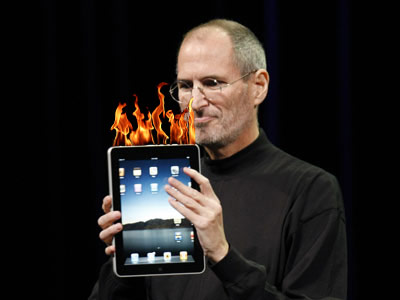
AT LARGE Fake News Friday: iPad Users Pretty Much OK With Them Catching Fire


CUPERTINO, Calif. (CAP) - Reports of the new version of the iPad heating to exorbitant temperatures have not fazed Apple's customers, who say that to have the company's latest technology they're more than willing to put up with slight inconveniences, such as catching on fire.

"It's really not a big deal," said Vallco Mall shopper Pete Hearst, 29, while tossing his iPad back and forth from hand to hand to avoid burning his fingers. "Just don't hold it for too long, or touch it, and it's not really a problem.

"I mean, look at that screen!" he added. "The picture's not even blurry even though I'm tossing it in the air. I mean, wow."

In Cambridge, Mass., longtime Apple products user Jason Knowlton, 22, agreed, noting that the screen resolution was "just awesome - did you know it has more colors than the human eye can see?" Particularly Knowlton's eyes, which were burned when flames shot out of his device 10 minutes after he first started using it.

"But it was the best 10 minutes of my life," he said, noting that the blindness is only temporary, and actually less painful than the time he accidentally inhaled an iPod shuffle.

According to Apple spokesperson Shelley Chambers, the new iPad is actually operating within technical specifications, "give or take a few dozen degrees."

"Early adopters understand that each iteration of a new technology is going to have its own unique facets," and that some of those facets could involve excess heat or the occasional explosion, she said.

"The early astronauts knew about those risks, and so do Apple customers," said Chambers. "It's sort of like the same thing."

Users of the Microsoft Zune have faced similar issues with their devices, seeing early models shut down on New Year's Eve and cause acute dermatitis. Asked whether more recent models have resolved those issues, Microsoft spokesman Paul Schlemp responded, "You mean we still make those?"

Schlemp declined to comment on whether the current iPad problems could be related to the exploding European iPhones and iPads that Microsoft was accused of sabotaging in 2009. "I could tell you, but then I'd have to time out your operation while waiting for a response from the receiving (POP) server," he said.

"Just a little Microsoft humor there," he added, then laughed like a donkey.

[Read the rest at CAP News.]

Wednesday, February 24, 2010

COLUMN: Google is making us even more stupider


My son, who’s 8, recently asked me, “Dad, how does Google know everything?” I took this to mean that I’ve been entirely too transparent about the source of my vast fatherly knowledge.

At first I thought about responding the same way I do when my kids ask me where babies come from (“Do I look like a doctor?”), but instead I decided to try to explain about how Google’s advanced system of algorithms crawls a vast worldwide network of computer databases. Not that I knew that — I had to Google it.

The fact of that matter is, to the benefit of any parent ever asked by a child why the sky was blue (“Do I look like a meteorologist?”), we now live in an age where no question need remain unanswered. Remember back before the Internet, when you walked around for days trying to remember who sang that song about Oz never giving nothing to the Tin Man? How did we survive those dark times?

So you can imagine my surprise when I read recently that there are those who insist that Google, despite being an unfettered source for infinite information, is actually making us all stupid. This would explain A LOT.

According to analyst Nicholas Carr in the Atlantic Monthly, using Google-found tidbits to skim the Web is keeping us from the type of “focused reading” that sets off “intellectual vibrations,” essentially making us stupider. Of course, his theory seems predicated on a dubious premise, namely that before Google, we all used to read the Atlantic Monthly from cover to cover in order to cleanse our palates between massive Proust marathons.

Of course, if you think back to pre-Web days, you’ll recall that what we were actually doing was watching “Married With Children.” Then, when the Internet came around, we took to the “Married With Children” message boards so we could call each other wankers.

But not everyone agrees with Mr. Carr. Jamais Cascio, also writing for Atlantic Monthly, said the Google method really helps us hone our ability to find “meaning in confusion.” For instance, if you Google “Lady Gaga,” you’ll get 75 million results; rather than become paralyzed by this overload of information, you will likely learn to focus your search to, say, “pictures of Lady Gaga wearing doilies.”

By contrast, if this were 1984 and you wanted to hone in on Madonna, you’d have to sit on the edge of your bed staring at the cover of “Like a Virgin” for hours on end. Er, not me. Other people.

The controversy is part of a study by the Pew Internet & American Life Project, which surveyed hundreds of “technology stakeholders,” according to PC World. (I can only presume these are the people with bigger, more expensive TVs than I have, which is everybody.) The stakeholders said that Google is probably not making us stupid, although I think we should take into account the possibility that it already has, and that when they’re not taking surveys, the stakeholders mostly just sit around going “Pew … Heh, that’s a funny word.”

Not that they don’t have concerns. As stakeholder and University of Pennsylvania Prof. Oscar Gandy told PC World, “the kind of Googled future that I am concerned about is the one in which my every desire is anticipated, and my every fear avoided by my guardian Google.” Which I agree would be terrible, in the same way that having a robot butler would be terrible — you know, that awesome kind of way.

Carr, for his part, is sticking to his guns. “The price of zipping among lots of bits of information is a loss of depth in our thinking,” he insists in the PC World article, and I’m assuming in his original Atlantic story as well. Although I can’t be positive, because I didn’t actually read it — I Googled it, but, well, I never clicked any of the links. I can point you to several hundred thousand fascinating pictures of Lady Gaga, though.

Gaga … Heh, that’s a funny word.

This column appeared originally in North Shore Sunday. Peter Chianca is a managing editor for GateHouse Media New England. Follow him on Twitter at twitter.com/pchianca. To receive At Large by e-mail, write to info@chianca-at-large.com, with the subject line “SUBSCRIBE.”

Wednesday, February 03, 2010

COLUMN: Buy an iPad, feed a journalist!


As my regular readers know, I have a long history of trying to get the Apple corporation to send me free electronic equipment in exchange for a mention in this column. I have been wholly unsuccessful at this from the very beginning, when I tried to get them to ship me an Apple II to review for my elementary school newspaper. I suspect Steve Jobs may have something against the mimeograph.

More recently, I’ve tried to get them to send me test models of the various iPods (40 GB, Touch, Shuffle, Nano with Pocketknife, etc.), but they continue to insist on sending them places like PC World and CNET — places that cover, you know, technology, rather than the things I write about, such as when we’re most likely to be overrun by killer zombies. This is of course ironic, since technology reporters will be among the first to go when the zombies finally do attack.

But now Apple has introduced the iPad (motto: Enough With The Feminine Hygiene References Already), its new tablet computer — which, beyond being the latest cool-looking electronic device that I can’t afford, has another, much more important designation: It might just save newspapers. Also, I’m pretty sure that in a pinch you could slice meat on it.

As you may have heard, we in the newspaper business have been looking for ways to turn around our struggling industry. So far we’ve come up with the following ideas:

1) After readers have viewed a certain number of stories on the Internet, charge them … one meeeelllion dollars!

2) Print only pictures of good-looking people. Oh, we’re already doing that? OK, good-looking naked people.

3) Tell people they really should subscribe if they ever want to see Fluffy alive again.

Our main problem, of course, is that people won’t pay to read news on their computer, seeing as how online news is self-generated for free from the dust that gathers in the joint fittings on the Internet tubes. But the iPad isn’t a computer — it’s a slick, slate-like device that does computing, yes, but whose underlying purpose is much more all-encompassing: namely, to make people feel more like Captain Picard. (You know who you are.)

With the iPad, you can take your local newspaper — along with the Web, videos, photos, the latest Lady Gaga single, etc. — into your Starship’s ready room, or anywhere else you want to go. (Well, except the bathtub … boy, did Steve Wozniak find that out the hard way.) And it’s better than a laptop, because you don’t have to unfold it — if we could harness the energy spent every day on folding and unfolding laptops, we could power … well, not an iPad, but probably one of those Itty Bitty Book Lights.

But why, if people won’t pay 75 cents for their newspaper, will they pay $829 plus $30 per month for a loaded iPad? Because it’s got an “i” in front of its name, that’s why! Sure, it sounds silly, but when the thing goes on sale, throngs of people will line up to get it, and CNN will air footage of the skinny, latte-addled hipster who claws his way to the front of the line to buy the first one. (His name is Hugo.)

And then, the part that will warm the hearts of newspaper people the world over: Thousands of consumers will fire it up and immediately use their credit cards to order exclusive iPad subscriptions to the New York Times. And when I say “New York Times” I of course mean, “one of the 50-plus available fart-noise apps.” Sure, that they’ll pay for.

Still, baby steps — we didn’t obliterate the publishing industry overnight, and we don’t expect the iPad to save it for at least three or four more weeks. In the meantime, Apple, I’ll be waiting. You can send me my free iPad in care of this newspaper.

Er, for the time being.

This column appeared originally in North Shore Sunday. Peter Chianca is a managing editor for GateHouse Media New England. Follow him on Twitter at twitter.com/pchianca. To receive At Large by e-mail, write to info@chianca-at-large.com, with the subject line “SUBSCRIBE.”